
The persistence of product and process innovation in SMEs: The moderating effect of government support systems
1 Ajou University
DOI: https://doi.org/10.17287/kbr.2026.30.2.195
Abstract
Small and medium-sized enterprises (SMEs) play a pivotal role in the national economy. In particular, the manufacturing sector accounts for a substantial share of domestic employment, exports, and domestic demand. Consequently, the manufacturing capabilities of SMEs, specifically their product and process innovation capabilities, are critical determinants of corporate survival, and the government supports these firms through a variety of institutional schemes. This study analyzes the moderating effect of government support systems on the relationship between the performance of product and process innovation and innovation persistence. Data from the 2024 Manufacturing Sector of the Korean Innovation Survey (KIS), conducted by the Science and Technology Policy Institute (STEPI), were utilized, with a total of 1,850 SMEs selected as the final sample for analysis. The results indicate that innovation activities inherently contribute to maintaining innovation persistence. Furthermore, government support generally demonstrated a positive moderating effect on process innovation, with financial support showing a particularly significant impact. However, the interaction between process innovation and technical support was not found to be statistically significant. This study contributes to the literature by demonstrating that the expected effects of government support for innovation activities may vary depending on the support type. Moreover, the findings offer practical implications for firms in formulating strategies to leverage external support effectively.
Ⅰ. Introduction
As of the end of 2023, Small and medium-sized enterprises (SMEs) play a pivotal role in the domestic economy, accounting for 99.9% of all enterprises, 80.4% of total employment, and 44.9% of total sales. Within the SME sector, while manufacturing firms constitute only 7.4% of the total number of enterprises, they account for 17.8% of employment and 24.8% of sales. These figures demonstrate that the manufacturing sector holds a substantial weight in domestic employment, exports, and domestic demand. Therefore, enhancing the productivity of manufacturing SMEs is crucial, not only for individual firms but also for the national economy. Recognizing this, governments worldwide are providing extensive support to improve corporate productivity. Key examples include tax incentives such as R&D tax credits, financial support including loans, technical assistance, support for technical personnel, and provision of access to research equipment.
One effective method for enhancing the productivity of manufacturing firms is the innovation of their existing products or processes. Furthermore, the persistence of such innovation is crucial for the sustainable survival and growth of the firm. Continuous innovation is essential for firms to adapt to rapidly changing internal and external environments. Given that product innovation and process innovation differ in their nature and development trajectories, the effectiveness of government support is also expected to vary accordingly. As discussed, government support, the types of innovation in SMEs, and innovation persistence are critical factors for corporate survival. However, there is a lack of clear research on how specific government support schemes influence innovation persistence with respect to product or process innovation. Previous studies have primarily focused on the effects of government support on the generation of innovation performance, and research specifically targeting manufacturing SMEs has been relatively scarce. Therefore, the significance of this study lies in verifying the ex-post effects of government support by setting “innovation persistence” from a medium-term perspective as the dependent variable. Furthermore, rather than treating government support as a single variable, it analyzes the interactions between the characteristics of the support systems and the types of firm innovation in detail. Through this, the study can provide empirical and detailed policy implications for manufacturing SMEs. This study utilizes data from the 2024 Manufacturing Sector of the Korean Innovation Survey (KIS), conducted by the Science and Technology Policy Institute (STEPI), to analyze the impact of innovation activities by type on innovation persistence. In this analysis, the type of government support is established as a moderating variable.
This paper is organized as follows. Chapter 2 reviews the literature on product and process innovation in SMEs, government support activities, and innovation persistence, followed by the development of research hypotheses. Chapter 3 describes the data and research model. Chapter 4 presents the empirical results derived from the research model and offers an interpretation of the findings. Finally, Chapter 5 discusses the conclusions and limitations of the study.
Ⅱ. Literature Review and Hypothesis Development
Technological innovation significantly influences competitiveness at individual, corporate, national, and societal levels, and its importance continues to expand. The concept of innovation is employed across a wide range of scopes, from firm-level management strategies to national or regional technological supremacy (Min et al., 2025). While innovation is inherently important, appropriating the benefits derived from it is a distinct issue. For instance, Teece (1986) addressed the phenomenon where innovating firms lose profits to followers or other entities. He explained the key factors determining commercial success using a framework of three elements: appropriability, complementary assets, and dominant design. He argued that appropriability is significantly low when legal protection mechanisms like patents are weak or in cases like process innovation where legal protection is difficult. In environments where imitation is easy, he asserted that the ownership of complementary assets, which are essential for successfully establishing the innovation in the market, determines the beneficiary of the profits, rather than the value of the innovation itself. Romer (1990) laid the foundation for endogenous growth theory, arguing that technological change, the driving force of economic growth, is an endogenous phenomenon occurring within the economic system. Defining knowledge (technology) as a non-rival but partially excludable good, he posited that these characteristics provide firms with a strong incentive to develop new technologies to secure monopolistic profits. Abernathy and Utterback (1978) described innovation as an industrial pattern. They explained that industrial evolution begins with radical product innovation, passes through a dominant design, and ultimately culminates in incremental process innovation.
Regarding product and process innovation in manufacturing, key research areas include performance, patents, SMEs, product development, and organization (Hong et al., 2008; Jeon and Chung, 2014; Marzi et al., 2017), leading to extensive research in these domains. The characteristics of product and process innovation within a firm can be explained by the firm's developmental stage and competitive strategy (Utterback and Abernathy, 1975). In the early stages of the product life cycle, processes are uncoordinated, and the rate of product innovation is at its highest. In the subsequent stage, radical product innovation diminishes, and firms shift their focus to process innovation to produce standardized products more efficiently for sales maximization. Finally, in the systemic process stage where products become standardized and stabilized, competitive strategies shift toward price and cost minimization, with the rate of process innovation surpassing that of product innovation.
This trend is also supported by quantitative evidence. As firm size increases, the cost of process innovation tends to rise much more strongly than that of product innovation. In contrast, smaller firms are found to allocate a higher proportion of their total R&D budget to product innovation (Fritsch and Meschede, 2001).
Given this evolutionary process of manufacturing firms, it is crucial to identify the correlation between a firm's R&D capabilities, innovation types, and performance. Furthermore, the innovation capabilities of SMEs can vary depending on the strategic path chosen. For instance, product development strategies directly strengthen knowledge acquisition capabilities by increasing the success rate of product commercialization. In contrast, process development strategies may hinder internal creativity and reduce organizational flexibility due to an excessive focus on efficiency (Branzei and Vertinsky, 2006). Open innovation in SMEs can have a positive impact on both product and process innovation. This includes both inbound activities, which involve introducing external knowledge and technology, and outbound activities, which involve selling or transferring internal technology externally (Madrid-Guijarro et al., 2021). Regarding process innovation in SMEs, Hervas-Oliver et al. (2014) argued that R&D investment does not directly influence productivity improvement. They concluded that effective process innovation driving productivity growth in SMEs is achieved not through internal technology development via R&D, but through the purchase of machinery or equipment embedded with proven external technologies. Therefore, a strategy that pursues this in conjunction with “organizational innovation,” which combines introduced technical innovation with organizational operations, is more effective. Conversely, Medda (2020), in an analysis of external R&D expenditure in European manufacturing firms (e.g., France, Germany), argued that external R&D had a positive effect when process innovation was pursued alone or simultaneously with product innovation, but showed no significant effect when limited to product innovation. It is also important to select and match the appropriate type of external knowledge to the firm's innovation goals. The linkage of “upstream knowledge” based on interactions and transactions with suppliers had a positive effect on process innovation, whereas its impact on product innovation was relatively minor. Conversely, horizontal knowledge from competitors and “downstream knowledge” from customers were found to have a stronger positive influence on the introduction of product innovation (Antonelli and Fassio, 2016). This can also be interpreted from the perspective of subcontractors. Unlike “traditional subcontracting” relationships that only focus on manufacturing products, “collaborative outsourcing” relationships are characterized by participation in product and process development, low dependence due to holding multiple clients, and stable contracts based on trust. In these collaborative relationships, the probability of performing both product and process innovation was found to be significantly higher (Bocquet, 2011).
Innovation persistence is of significant importance because it enables sustained firm growth. Furthermore, firms with prior innovation experience show a significantly higher probability of innovating again, and there are complementary effects between product and process innovation (Martinez-Ros and Labeaga, 2009). Previous studies have generally posited that product innovation exhibits greater persistence than process innovation due to differences in their key drivers. Product innovation persistence is deeply related to strategic factors such as maintaining a long-term market position. In contrast, process innovation appears to be driven more frequently by motives to respond to market pressures, such as cost reduction (Roper and Hewitt-Dundas, 2008). When controlling for complementary effects, stronger persistence is observed in product innovation compared to process innovation. Specifically, the persistence of process innovation is strong when accompanied by product innovation, but it tends to be a one-off event when pursued in isolation (Antonelli et al., 2012). These findings imply that public support for R&D activities and product innovation is likely to generate sustainable long-term effects, whereas subsidies for the introduction of process innovation are more likely to yield only short-term effects. Firms that achieve high innovation persistence generally pursue market-driven, R&D-intensive, and science-based strategies. Notably, while R&D-intensive strategies have a positive impact on product innovation, their influence on process innovation appears to be relatively weaker compared to product innovation (Clausen et al., 2011). The results remain consistent even when innovation types are categorized more granularly. Analysis shows that product innovation exhibits the strongest persistence, followed by process and organizational innovations which show similar levels of persistence, while marketing innovation demonstrates the weakest persistence (Tavassoli and Karlsson, 2015).
External R&D support is also a key factor in corporate innovation. While government R&D subsidies may not directly affect innovation performance, they have a significant indirect positive effect on innovation performance by fostering two knowledge-sourcing activities: “R&D effort” and “technological openness” (Afcha and Lucena, 2021). Furthermore, R&D subsidies have a positive impact on both the number of patent applications and the probability of application. The number of patent applications showed a significant effect for all beneficiary firms, while the probability of application was significant for small firms. Notably, the effect on the number of applications was found to be greater for small firms (Bronzini and Piselli, 2016). However, some studies suggest that the items for R&D subsidies need to be selected carefully. Generally, subsidies for research that is “far from the market” showed a positive effect in stimulating internal R&D expenditure. In contrast, subsidies for development that is “close to the market” substituted for the firm's own R&D spending, thereby demonstrating a crowding-out effect that reduced R&D expenditure (Clausen, 2009). Government R&D subsidies also have a positive impact on firms' technological innovation efficiency. Since subsidies are linked to corporate innovation performance such as patent applications and new product development, they stimulate firms to increase R&D expenditure and improve the efficiency of innovation processes. Additionally, they act as a signal that enhances external confidence in R&D efforts, thereby facilitating external financing and further promoting technological innovation (Zhang et al., 2024). The effect also varies depending on the source of the subsidy. For example, in the case of German firms, innovation inputs such as R&D expenditure were most effective when funding was received from both national and EU sources. Regarding innovation output, firms receiving funding from both sources had the highest sales of “new-to-market” products, whereas “total innovation sales” were higher for firms receiving national subsidies (Czarnitzki and Bento, 2014). The effects also differ when utilizing external knowledge from sources other than simple subsidies, such as suppliers, users, competitors, universities, and research institutions. Cooperation with users, competitors, universities, and research institutions had a positive impact on both process and product innovation. However, suppliers showed no significant influence or even a negative effect on process innovation. This effect appeared differently across types, such as scale-intensive firms and specialized suppliers (Si et al., 2020).
Synthesizing the findings from previous studies, innovation appears to be self-reinforcing; thus, firms that innovate are expected to continue innovating regardless of the type. While the effect of government support on persistence remains ambiguous, its impact is expected to vary depending on the type of innovation. Particularly when viewed from a short-term perspective, the effect of support is expected to be more positive for process innovation compared to product innovation, which requires a relatively longer duration. Therefore, the hypotheses of this study are as follows:
H1a. The performance of product innovation will have a positive effect on the persistence of the innovation itself.
H1b. The performance of process innovation will have a positive effect on the persistence of the innovation itself.
H2. Government support will have a positive effect on innovation persistence as a moderator for the performance of process innovation.
Ⅲ. Data and Methodology
To analyze the impact of government support on the persistence of innovation types in SMEs, this study utilized data from the 2024 Manufacturing Sector of the KIS. The survey targeted firms active in Korea between 2021 and 2023 and investigated innovation-related aspects, including innovation performance, activities, and facilitators and barriers to innovation, as well as basic firm information such as firm type, sales, establishment year, industry, and region.
The survey was conducted based on the OECD's Oslo Manual which provides fundamental guidelines for innovation surveys. The sample was collected through statistical procedures covering the entire domestic manufacturing sector, resulting in a total of 4,595 surveyed firms. By industry, the “manufacture of other machinery and equipment” accounted for the largest share with 654 firms, followed by the “manufacture of motor vehicles and trailers” with 465 firms. This study focused on SMEs as the subject of analysis, initially identifying a target pool of 3,760 firms. Among these SMEs, the “manufacture of other machinery and equipment” was the most prevalent with 554 firms, followed by the “manufacture of fabricated metal products” with 394 firms. After excluding firms with missing values, a total of 1,850 manufacturing SMEs were selected as the final subjects for analysis.
To verify the research hypotheses, the dependent variable was set as the response regarding the persistence of innovation activities as of the end of 2023 (R&D_keep). Respondents answered this variable with either "Yes" or "No". For independent variables, the study utilized the status of product innovation (Product_innov) and process innovation (Process_innov). The survey categorized product innovation into goods innovation and service innovation. In this study, it was assumed that product innovation was performed if the respondent reported conducting at least one of these two innovation types. Process innovation refers to activities that influence sales by improving production, distribution, administration, marketing methods, or organizational structure. The survey investigated the performance of seven types of process innovation, and this study considered process innovation to have been performed if the respondent reported conducting at least one of them. Government support policies utilized by firms by type were established as moderating variables. Government support systems are classified into tax, funding, finance, personnel, technology, certification, and purchase support. In this study, government support was broadly categorized into three types: financial support (Gov_finance), technical support (Gov_tech), and other support (Gov_others). Tax, funding, and finance support were included in financial support, while personnel, certification, and purchase support were included in other support. The technical support variable was used independently. In the survey, respondents evaluated the importance of government support, where 0 indicates no utilization, and the scale from 1 to 5 ranges from “very low” to “very high”. The government support system variables in this analysis do not represent the direct scale of government support received by the firm. However, since firms evaluate importance when they utilize government support systems, this study assumed that these variables sufficiently represent the role of government support systems as perceived by the firms. Firm size (Emp), exports (Export), firm age (Age), industry, and region were used as control variables. Firm size was set as the number of permanent employees as of 2021 reported by the respondent, and exports were based on the export amount in 2021 reported by the respondent. Dummy variables were applied for industry at the division level and for region as capital or non-capital areas (Table 1
Table 1 Descriptive Statistics
| Variable | Mean | Standard Deviation | Min | Max |
|---|---|---|---|---|
| R&D_keep | 0.34 | 0.47 | 0.00 | 1.00 |
| Product_innov | 0.74 | 0.44 | 0.00 | 1.00 |
| Process_innov | 0.63 | 0.48 | 0.00 | 1.00 |
| Gov_finance | 0.99 | 1.34 | 0.00 | 5.00 |
| Gov_tech | 0.59 | 1.28 | 0.00 | 5.00 |
| Gov_others | 0.71 | 1.10 | 0.00 | 5.00 |
| Emp | 3.73 | 1.06 | 2.30 | 9.46 |
| Export | 3.04 | 4.28 | 0.00 | 17.89 |
| Age | 20.37 | 11.67 | 1.00 | 82.00 |
Table 2 Correlation Matrix
| Variable | (1) | (2) | (3) | (4) | (5) | (6) | (7) | (8) | (9) |
|---|---|---|---|---|---|---|---|---|---|
| (1) R&D_keep | 1.00 | ||||||||
| (2) Product_innov | 0.32 | 1.00 | |||||||
| (3) Process_innov | 0.29 | 0.37 | 1.00 | ||||||
| (4) Gov_finance | 0.29 | 0.14 | 0.10 | 1.00 | |||||
| (5) Gov_tech | 0.17 | 0.04 | 0.09 | 0.59 | 1.00 | ||||
| (6) Gov_others | 0.23 | 0.07 | 0.06 | 0.70 | 0.70 | 1.00 | |||
| (7) Emp | 0.21 | -0.04 | 0.09 | 0.30 | 0.17 | 0.22 | 1.00 | ||
| (8) Export | 0.22 | -0.02 | 0.10 | 0.25 | 0.18 | 0.21 | 0.57 | 1.00 |
Given that the dependent variable is binary, this study employed a logit model. Accordingly, the research model is specified as follows:
In the equation above, $logit(P)$ denotes $\log(P/(1-P))$. $Gov_i$ represents the government support system variable, $X_i$ represents the vector of control variables, and $\epsilon_i$ denotes the error term.
To ensure the robustness of the study, an additional analysis was conducted by dividing firms into two groups based on the median firm size, comprising those above the median and those below the median. This analysis examines whether innovation persistence varies depending on firm size.
Ⅳ. Results
Table 3 presents the regression analysis results of the research model used to verify the impact on the persistence of innovation activities for SMEs participating in this survey. In the first model, both product innovation and process innovation were found to have a statistically significant positive effect on the persistence of innovation activities. Conversely, government financial support itself did not show significant results. Also, the interaction effect between product innovation and government financial support was not significant. However, the interaction term with process innovation showed a statistically significant positive relationship.
In the second model, similar to the first model, product innovation and process innovation were found to have a positive effect on innovation persistence. While the government technical support variable itself was found to be insignificant, the moderating effect between process innovation and government technical support showed weakly significant results. Synthesizing the overall results, government support for product innovation did not show significant results. In contrast, government financial and other support for process innovation both appeared to have statistically significant positive effects. In the case of government technical support for process innovation, it was not significant at the 5% level but showed a significant effect at the 10% level. This suggests results similar to other types of support mentioned earlier even if the statistical significance is somewhat weak. However, given that the effect of technical support is somewhat uncertain, it can be interpreted that financial and other support have a clearer effect on the persistence of process innovation in firms. Since the government's overall innovation support policy for manufacturing SMEs did not produce valid results for product innovation, it can be inferred that government support acts more effectively on the persistence of process innovation rather than product innovation. Regarding other control variables, firm size and export variables appeared to have a positive effect on sustaining innovation. In the case of firm age, the influence was positive, but the statistical significance was somewhat weak.
Figure 1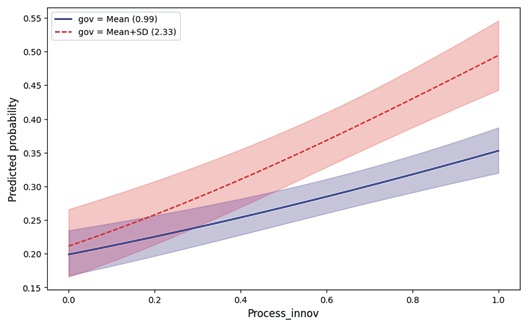
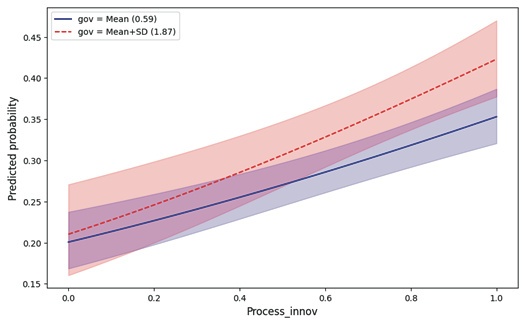
Table 3 Regression Results
| (1) | (2) | (3) | |
|---|---|---|---|
| Product_innov | 1.888*** (0.239) | 1.974*** (0.224) | 1.909*** (0.238) |
| Process_innov | 0.460** (0.168) | 0.703*** (0.147) | 0.486** (0.163) |
| Gov_finance | 0.133 (0.135) | ||
| Gov_tech | 0.071 (0.131) | ||
| Gov_others | -0.039 (0.155) | ||
| Product_innov * Gov_finance | -0.077 (0.139) | ||
| Process_innov * Gov_finance | 0.382*** (0.103) | ||
| Product_innov * Gov_tech | -0.076 (0.133) | ||
| Process_innov * Gov_tech | 0.208+ (0.121) | ||
| Product_innov * Gov_others | -0.024 (0.169) | ||
| Process_innov * Gov_others | 0.495*** (0.137) | ||
| Emp | 0.163* (0.072) | 0.266*** (0.072) | 0.230** (0.072) |
| Export | 0.061*** (0.017) | 0.067*** (0.016) | 0.061*** (0.017) |
| Age | 0.009+ (0.005) | 0.010* (0.005) | 0.010+ (0.005) |
| const | -3.405*** (0.406) | -3.814*** (0.397) | -3.599*** (0.403) |
| Region-fixed effects | Yes | Yes | Yes |
| Industry-fixed effects | Yes | Yes | Yes |
| Obs | 1,850 | 1,850 | 1,850 |
| R^2 | .2371 | .2130 | .2269 |
*** p<.001, ** p<.01, * p<.05, + p<.10
Table 4 Regression Results for Firms above Median Size
| (1) | (2) | (3) | |
|---|---|---|---|
| Product_innov | 2.357*** (0.449) | 2.328*** (0.375) | 2.239*** (0.409) |
| Process_innov | 0.516 (0.348) | 0.897*** (0.271) | 0.756* (0.305) |
| Gov_finance | 0.320* (0.158) | ||
| Gov_tech | 0.230 (0.143) | ||
| Gov_others | 0.305+ (0.171) | ||
| Product_innov * Gov_finance | -0.282 (0.203) | ||
| Process_innov * Gov_finance | 0.407* (0.173) | ||
| Product_innov * Gov_tech | -0.237 (0.180) | ||
| Process_innov * Gov_tech | 0.243 (0.162) | ||
| Product_innov * Gov_others | -0.212 (0.226) | ||
| Process_innov * Gov_others | 0.376* (0.187) | ||
| Emp | 0.269 (0.178) | 0.140 (0.120) | 0.132 (0.118) |
| Export | 0.065** (0.021) | 0.070*** (0.020) | 0.063** (0.021) |
| Age | 0.016* (0.007) | 0.017** (0.007) | 0.015* (0.007) |
| const | -3.624*** (0.680) | -3.864*** (0.665) | -3.809*** (0.669) |
| Region-fixed effects | Yes | Yes | Yes |
| Industry-fixed effects | Yes | Yes | Yes |
| Obs | 915 | 915 | 915 |
| R^2 | .2973 | .2703 | .2878 |
*** p<.001, ** p<.01, * p<.05, + p<.10
Table 5 Regression Results for Firms below Median Size
| (1) | (2) | (3) | |
|---|---|---|---|
| Product_innov | 1.433*** (0.299) | 1.443*** (0.297) | 1.281*** (0.308) |
| Process_innov | 0.291 (0.212) | 0.487* (0.198) | 0.145 (0.210) |
| Gov_finance | -0.095 (0.308) | ||
| Gov_tech | -0.190 (0.400) | ||
| Gov_others | -1.158** (0.433) | ||
| Product_innov * Gov_finance | 0.085 (0.268) | ||
| Process_innov * Gov_finance | 0.366* (0.161) | ||
| Product_innov * Gov_tech | 0.232 (0.330) | ||
| Process_innov * Gov_tech | 0.046 (0.219) | ||
| Product_innov * Gov_others | 0.640+ (0.372) | ||
| Process_innov * Gov_others | 0.821** (0.253) | ||
| Emp | 0.318 (0.250) | 0.371 (0.250) | 0.416 (0.253) |
| Export | 0.057+ (0.033) | 0.067* (0.032) | 0.061+ (0.033) |
| Age | -0.007 (0.009) | -0.006 (0.009) | 0.006 (0.010) |
| const | -3.106*** (0.799) | -3.298*** (0.738) | -3.037*** (0.791) |
| Region-fixed effects | Yes | Yes | Yes |
| Industry-fixed effects | Yes | Yes | Yes |
| Obs | 935 | 935 | 935 |
| R^2 | .1793 | .1674 | .1804 |
*** p<.001, ** p<.01, * p<.05, + p<.10
These results are similar to the analysis results presented in Table 3. In the general analysis, the interactions between process innovation and government financial support as well as other support were found to be significant, and this pattern was similarly observed in Table 4 and Table 5. Therefore, regarding the moderating effects of financial support and other support, it appears that they have a positive influence on the persistence of process innovation regardless of firm size.
Table 6 Regression Results (2SRI Model)
| (1) | (2) | (3) | |
|---|---|---|---|
| First-stage (government support) | |||
| External_info | 0.649*** | 0.539*** | 0.560*** |
| (0.035) | (0.036) | (0.029) | |
| Product_innov | 0.310*** | -0.065 | 0.068 |
| (0.068) | (0.069) | (0.057) | |
| Process_innov | 0.124* | 0.254*** | 0.087+ |
| (0.062) | (0.063) | (0.051) | |
| const | -0.907*** | -0.466** | -0.323* |
| (0.155) | (0.158) | (0.130) | |
| Second-stage (innovation persistence) | |||
| Product_innov | 1.697*** | 1.956*** | 1.816*** |
| (0.240) | (0.226) | (0.236) | |
| Process_innov | 0.481** | 0.585*** | 0.519** |
| (0.169) | (0.149) | (0.163) | |
| Gov_finance | 0.539** | ||
| (0.187) | |||
| Gov_tech | 0.840*** | ||
| (0.200) | |||
| Gov_others | 0.532* | ||
| (0.216) | |||
| Product_innov * Gov_finance | -0.056 | ||
| (0.144) | |||
| Process_innov * Gov_finance | 0.348*** | ||
| (0.103) | |||
| Product_innov * Gov_tech | -0.068 | ||
| (0.136) | |||
| Process_innov * Gov_tech | 0.195 | ||
| (0.125) | |||
| Product_innov * Gov_others | -0.016 | ||
| (0.172) | |||
| Process_innov * Gov_others | 0.456** | ||
| (0.139) | |||
| residuals | -0.472*** | -0.863*** | -0.664*** |
| (0.135) | (0.161) | (0.162) | |
| const | -3.121*** | -3.576*** | -3.533*** |
| (0.408) | (0.395) | (0.402) | |
| Control variables | Yes | Yes | Yes |
| Region-fixed effects | Yes | Yes | Yes |
| Industry-fixed effects | Yes | Yes | Yes |
| Obs | 1,850 | 1,850 | 1,850 |
| R^2 | .2430 | .2275 | .2352 |
*** p<.001, ** p<.01, * p<.05, + p<.10
Table 7 Regression Results (High-technology industries)
| (1) | (2) | (3) | |
|---|---|---|---|
| Product_innov | 1.894*** (0.331) | 2.119*** (0.316) | 1.965*** (0.342) |
| Process_innov | 0.528* (0.239) | 0.658** (0.201) | 0.480* (0.237) |
| Gov_finance | 0.188 (0.165) | ||
| Gov_tech | 0.230 (0.166) | ||
| Gov_others | 0.067 (0.213) | ||
| Product_innov * Gov_finance | 0.013 (0.176) | ||
| Process_innov * Gov_finance | 0.245+ (0.131) | ||
| Product_innov * Gov_tech | -0.080 (0.167) | ||
| Process_innov * Gov_tech | 0.080 (0.144) | ||
| Product_innov * Gov_others | 0.036 (0.233) | ||
| Process_innov * Gov_others | 0.371* (0.178) | ||
| Emp | 0.041 (0.092) | 0.143 (0.093) | 0.107 (0.093) |
| Export | 0.086*** (0.022) | 0.091*** (0.022) | 0.084*** (0.022) |
| Age | 0.007 (0.007) | 0.008 (0.007) | 0.006 (0.007) |
| const | -3.387*** (0.507) | -3.828*** (0.485) | -3.537*** (0.500) |
| Region-fixed effects | Yes | Yes | Yes |
| Industry-fixed effects | Yes | Yes | Yes |
| Obs | 1,050 | 1,050 | 1,050 |
| R^2 | .2454 | .2224 | .2359 |
*** p<.001, ** p<.01, * p<.05, + p<.10
Table 8 Regression Results (Low-technology industries)
| (1) | (2) | (3) | |
|---|---|---|---|
| Product_innov | 1.862*** (0.351) | 1.787*** (0.324) | 1.804*** (0.344) |
| Process_innov | 0.362 (0.245) | 0.696** (0.222) | 0.455+ (0.237) |
| Gov_finance | 0.095 (0.281) | ||
| Gov_tech | -0.199 (0.218) | ||
| Gov_others | -0.240 (0.241) | ||
| Product_innov * Gov_finance | -0.367 (0.317) | ||
| Process_innov * Gov_finance | 0.692*** (0.210) | ||
| Product_innov * Gov_tech | -0.121 (0.261) | ||
| Process_innov * Gov_tech | 0.479+ (0.272) | ||
| Product_innov * Gov_others | -0.221 (0.278) | ||
| Process_innov * Gov_others | 0.826** (0.274) | ||
| Emp | 0.357** (0.118) | 0.458*** (0.116) | 0.415*** (0.115) |
| Export | 0.021 (0.028) | 0.030 (0.027) | 0.030 (0.027) |
| Age | 0.011 (0.008) | 0.011 (0.008) | 0.012 (0.008) |
| const | -3.926*** (0.582) | -4.231*** (0.566) | -4.066*** (0.579) |
| Region-fixed effects | Yes | Yes | Yes |
| Industry-fixed effects | Yes | Yes | Yes |
| Obs | 800 | 800 | 800 |
| R^2 | .2381 | .2123 | .2262 |
*** p<.001, ** p<.01, * p<.05, + p<.10
Ⅴ. Conclusion
The innovation capabilities of manufacturing SMEs are a key element of the national economy, and efforts to sustain such innovation are also of critical importance. Accordingly, this study systematically analyzed the relationships among product and process innovation, various government support systems, and innovation persistence. The analysis results indicate that innovation itself contributes to maintaining innovation persistence, regardless of its type. Furthermore, while government support has a limited impact on innovation persistence itself, it exerts a significant effect in relation to the innovation currently being undertaken by the firm. Government support for product innovation generally did not show a significant effect on innovation persistence, whereas a positive effect was observed in the case of process innovation. This effect was particularly strong in financial support and other support. Similar results were obtained in the verification conducted to ensure the robustness of the study. Regardless of firm size and technology level, government financial support and other support were found to have a positive influence on the persistence of process innovation.
These results demonstrate consistency with the research hypotheses. Due to the characteristics of the data, this study surveyed whether innovation was sustained after zero to two years, which represents a relatively short period. Therefore, as confirmed in previous studies, unlike product innovation where effects manifest after a relatively long duration, positive results could be observed for process innovation even in the short term. In the case of government technical support, while short-term effects were weak, long-term effects can be anticipated, although this could not be verified in this study. Consequently, from a policy perspective, financial support may be more effective than technical support when seeking short-term effects for process innovation. However, since the long-term effects on product and process innovation could not be verified due to data limitations, caution is required in interpreting the results.
1. Supplementary Note
Specifically, the ISTANS framework classifies C313 (aerospace) as a “high-technology industry,” C312 (railways) and C319 (other transport equipment) as “medium-high-technology industries,” and C311 (shipbuilding) as a “medium-low-technology industry.” Consequently, taking into account the proportional weight and overall technological intensity of the sector, the aggregate C31 category was designated as a “High-technology industry.” Additionally, no firms corresponding to the C12 (tobacco manufacturing) sector are present in the dataset.
This study holds academic significance in that it empirically demonstrates the effects of government support from the perspective of persistence, one of the key factors for corporate survival. This is unlike previous innovation-related studies that mainly focused on its impact on innovation performance or the occurrence of innovation. Furthermore, by categorizing both support programs and innovation types to analyze their interplay, this study provides a multifaceted understanding of the moderating effects of government support. Also, this research provides specific implications for policymakers supporting the innovation of manufacturing SMEs. Having revealed that the combination of innovation type and government support program is important, there is a need to provide customized support packages for firms. Furthermore, when evaluating firm innovation performance, it is necessary to apply different grace periods for evaluation considering the characteristics of the support system and the type of innovation.
This study analyzed the impact of various government support systems on innovation persistence. However, due to the nature of cross-sectional data which lacks time-series elements, there was a limitation in identifying the long-term trends of firms. Therefore, it was difficult to identify the effects regarding the persistence of product innovation which is expected to require a long duration. In addition, since the survey does not include questions about the final period of the timeframe other than whether innovation persisted, and firms are not tracked longitudinally, this study had to rely on a simple variable for innovation persistence. Thus, a more accurate study could be conducted if a panel survey dataset were available that includes questions asking about innovation persistence over an extended period, or that defines sustained innovation performance as a continuous variable. Also, while this study used industry as a control variable, it could not identify the effects of government support that may vary by industry. Therefore, if future research utilizes panel data and analyzes this in more detail, it could provide more useful data for policy purposes.