
Value Formation and User Acceptance of Urban Air Mobility Services
1 HJ Institute of Technology and Management
2 Tech University of Korea
DOI: https://doi.org/10.17287/kbr.2026.30.2.41
Abstract
Urban air mobility (UAM) has emerged as a promising solution to urban congestion and mobility inefficiencies, yet public acceptance remains a critical challenge for its successful implementation. This study aims to explain user acceptance of UAM services by applying a value-based adoption perspective that integrates multiple evaluative beliefs. Survey data were collected from 252 respondents with prior awareness of UAM concepts. To test the proposed relationships, this study employed a cross-sectional survey design and analyzed the data using regression-based path analysis grounded in the value-based adoption model. The research examines how technological reliability, hedonic motivation, usefulness, and perceived cost contribute to perceived value, and how perceived value subsequently shapes intention to use. The findings indicate that technological reliability, hedonic motivation, and usefulness significantly enhance perceived value, while perceived cost does not exert a meaningful influence. Perceived value, in turn, plays a decisive role in shaping users’ intention to adopt UAM services. These results suggest that users evaluate UAM primarily through anticipated benefits and experiential expectations rather than cost considerations at the current stage of market development. The study offers theoretical contributions by extending value-based adoption research to emerging mobility contexts and provides practical implications for service providers and policymakers seeking to foster early user acceptance.
Ⅰ. Introduction
Rapid urbanization and the persistent growth of metropolitan populations have intensified challenges related to traffic congestion, travel time inefficiency, and environmental sustainability. Conventional ground-based transportation systems in major cities increasingly struggle to accommodate rising mobility demand, prompting policymakers and industry stakeholders to explore alternative transportation paradigms. In this context, urban air mobility (UAM) has emerged as a promising next-generation transportation concept that leverages electric vertical take-off and landing aircraft to enable short-distance aerial travel within and between urban areas (European_Union_Aviation_Safety_Agency, 2021; Li et al., 2025; Trapsilawati et al., 2025). By operating above ground congestion and relying on electric propulsion, UAM is often positioned as a time-efficient and environmentally friendly complement to existing transport infrastructures.
Despite significant technological progress and large-scale pilot projects worldwide, the successful deployment of UAM services depends fundamentally on public acceptance. Prior research consistently emphasizes that technical readiness alone does not guarantee adoption, particularly for safety-critical and unfamiliar mobility technologies (Al Haddad et al., 2020; Ju, 2022; Yun & Hwang, 2020). Because UAM involves aerial operations over densely populated areas, potential users are likely to evaluate such services through a complex lens that incorporates perceived safety, trust in technology, and institutional governance (Coppola et al., 2024; Lee, 2020; Vongvit et al., 2024). Consequently, understanding how individuals form evaluative judgments and adoption intentions toward UAM services has become a critical research priority.
Existing studies on UAM acceptance have largely adopted technology adoption and transport behavior frameworks, identifying factors such as reliability, usefulness, affordability, and trust as key antecedents of intention to use (Ju, 2022; Kim et al., 2023; Yavas & Tez, 2023). Scenario-based and stated-preference research further demonstrates that user acceptance varies substantially depending on contextual conditions, including route characteristics, integration with public transport, and perceived service benefits (Coppola et al., 2024; Riza et al., 2024). While these studies offer valuable insights, much of the literature examines individual determinants in isolation, providing limited explanation of how users synthesize diverse beliefs into an overall evaluation that ultimately drives adoption behavior. To address this limitation, scholars increasingly argue for integrative perspectives that capture the trade-off logic underlying consumer decision-making in emerging service contexts. One such perspective is the value-based adoption model (VAM), which conceptualizes adoption as a benefit–sacrifice evaluation process in which perceived value serves as the most proximal driver of behavioral intention (Kim et al., 2007). Rooted in consumer value theory, VAM posits that individuals assess what they expect to gain relative to what they expect to give up, forming a holistic value judgment that guides adoption decisions (Zeithaml, 1988). This approach extends beyond usefulness-centered models by explicitly incorporating both benefit-related beliefs, such as functional and experiential gains, and sacrifice-related beliefs, such as monetary cost and effort (Dodds et al., 1991).
While prior studies on UAM adoption have predominantly relied on technology acceptance model (TAM) frameworks, focusing on constructs such as perceived usefulness and perceived ease of use, these approaches tend to examine cognitive beliefs in isolation and offer limited explanation of how users integrate multiple evaluative dimensions into a unified judgment (Al Haddad et al., 2020; Ju, 2022). In contrast, the VAM provides a more comprehensive lens by conceptualizing adoption as a trade-off between perceived benefits and perceived sacrifices, with perceived value serving as a central evaluative mechanism (Kim et al., 2007; Zeithaml, 1988). This distinction is particularly important in the UAM context, where users face high uncertainty, lack prior usage experience, and must simultaneously evaluate functional performance, experiential expectations, and cost considerations. Unlike TAM-based approaches, which primarily emphasize utilitarian cognition, this study incorporates both hedonic motivation and perceived cost to capture a broader range of user evaluations. Furthermore, by empirically demonstrating that perceived cost does not significantly influence perceived value in the early stage of UAM adoption, this study reveals a context-specific limitation of traditional value assumptions and highlights the dominance of benefit-driven evaluations. Therefore, the present study contributes to the literature by extending value-based adoption theory to emerging mobility services and offering a more integrative and context-sensitive explanation of UAM acceptance.
Recent studies applying value-based perspectives to advanced mobility and digital services suggest that perceived value plays a central role in translating technological perceptions into adoption intention (Vishwakarma, 2024; Yang et al., 2025). In the context of UAM, where users face substantial uncertainty and lack prior usage experience, value-based evaluations may be particularly salient. Individuals are required to weigh anticipated benefits, such as time savings, convenience, and novel travel experiences, against perceived sacrifices related to price, accessibility, and safety concerns (Lee & Kim, 2025). However, empirical research explicitly applying VAM to UAM services remains limited, and the relative importance of benefit-oriented and sacrifice-oriented beliefs in shaping perceived value is not yet fully understood.
Moreover, prior adoption research has paid relatively little attention to the role of experiential factors in UAM evaluation. While functional usefulness and reliability are frequently examined, hedonic motivation—defined as the anticipated enjoyment and emotional gratification derived from technology use—has received less empirical attention in the UAM context. Studies in related domains suggest that hedonic considerations can meaningfully enhance perceived value, particularly for novel and experiential services (Gajdzik et al., 2025; Liu et al., 2018; van der Heijden, 2004). Whether such effects hold in the context of UAM, where excitement and novelty may coexist with safety concerns, warrants systematic investigation.
Against this backdrop, the present study aims to explain user acceptance of UAM services through a value-based adoption framework. Specifically, it examines how technological reliability, hedonic motivation, usefulness, and perceived cost jointly shape perceived value, and how perceived value subsequently influences intention to use UAM services. By integrating multiple evaluative beliefs into a coherent theoretical model, this study seeks to advance understanding of the cognitive mechanisms underlying UAM adoption. In doing so, it contributes to the emerging UAM literature by moving beyond fragmented determinant-based approaches and offering a comprehensive, value-centered explanation of user acceptance. The findings are expected to provide both theoretical insights for scholars and practical guidance for policymakers and service providers seeking to foster early adoption of UAM services.
The remainder of this paper is organized as follows. Section 2 reviews the literature on urban air mobility and the value-based adoption model, establishing the theoretical foundation of the study. Section 3 develops the research framework and presents the hypotheses. Section 4 describes the empirical methodology, including instrument development, data collection, and sample characteristics. Section 5 reports the results of the reliability and validity assessments as well as the hypothesis tests. Finally, Sections 6 and 7 discuss the findings, outline the theoretical and practical implications, address the study’s limitations, and suggest directions for future research.
Ⅱ. Literature Review
2.1 UAM
UAM refers to an emerging transportation system that uses electric vertical takeoff and landing aircraft to move people and goods within and between cities (European_Union_Aviation_Safety_Agency, 2021). Early research emphasizes that UAM’s diffusion hinges less on technical feasibility alone than on social acceptance, because perceived safety, noise, and governance shape public legitimacy and willingness to ride (European_Union_Aviation_Safety_Agency, 2021; Karami et al., 2024; Vongvit et al., 2024). Scenario-based studies show that acceptance varies by context (e.g., urban setting and integration with public transport) and that willingness to pay is highly sensitive to service framing and perceived benefits (Coppola et al., 2024; Riza et al., 2024; Trapsilawati et al., 2025; Zhao et al., 2024). Empirical adoption studies increasingly model UAM intentions using technology-adoption and transport-behavior lenses, highlighting reliability, usefulness, and affordability as key antecedents of intention (Al Haddad et al., 2020; Ju, 2022; Kim et al., 2023; Trapsilawati et al., 2025; Yavas & Tez, 2023). Recent evidence also suggests that trust-related beliefs and customer perceived value are central mechanisms that translate evaluations of UAM technology into intention to use it as a public transport option (Vongvit et al., 2024). Beyond passenger services, work on UAM logistics and deliveries indicates that acceptance may differ by use case, implying that “UAM” is not one uniform adoption problem but a bundle of distinct services with different perceived risks and benefits (Zhao et al., 2024). Related scholarship on advanced aerial mobility further shows that consumer willingness to fly depends on how individuals imagine operational conditions and safety assurance, reinforcing the importance of communication, demonstrations, and staged rollout strategies (Ison, 2024). Overall, the literature converges on the idea that UAM adoption is shaped by a layered evaluation process—risk and trust at the base, experienced and functional benefits above, and contextual constraints (pricing, infrastructure, trip purpose) that condition final acceptance (Lee & Kim, 2025).
2.2 VAM
The VAM explains technology adoption as a benefit–sacrifice evaluation in which perceived value becomes the most proximal driver of intention (Kim et al., 2007). The model builds on foundational consumer-value logic that defines value as an overall assessment of what is received relative to what is given, making value an evaluative summary rather than a single attribute (Zeithaml, 1988). VAM was formalized to address limitations of purely usefulness-centered accounts by integrating both utilitarian benefits (e.g., usefulness) and sacrifices (e.g., monetary cost, effort, time), and by positioning perceived value as a mediator linking beliefs to adoption intention (Kim et al., 2007). Pricing and sacrifice mechanisms are especially important because higher perceived cost can erode value even when quality beliefs are favorable, underscoring the trade-off structure that VAM makes explicit (Dodds et al., 1991). Subsequent work has applied value-centric reasoning across digital services and platforms, frequently finding that perceived value is a strong, behavior-proximal predictor compared with more distal beliefs (Kim & Kyung, 2025; Kim, 2023; Vishwakarma, 2024; Wong et al., 2025; Yang et al., 2025). For emerging mobility services, VAM is particularly suitable because users often face uncertainty and must weigh novel benefits (speed, experience) against perceived sacrifices (price, access, learning) (Lee & Kim, 2025). Thus, VAM provides a parsimonious theoretical bridge between technology beliefs and consumer choice under novelty, where adoption depends on whether the service “feels worth it” in the user’s own terms (Kim et al., 2007).
Ⅲ. Theoretical Development and Research Hypotheses
This study is grounded in the VAM, which explains technology acceptance as a result of users’ holistic evaluations of perceived benefits and sacrifices rather than isolated beliefs (Kim et al., 2007). In this framework, users form value judgments by integrating functional, experiential, and risk-related appraisals before developing usage intentions (Zeithaml, 1988). In emerging mobility services such as UAM, these evaluations are particularly salient due to technological novelty, safety concerns, and uncertainty surrounding outcomes (Ju, 2022). Drawing on technology acceptance and consumer value theories, this study conceptualizes technological reliability, hedonic motivation, and usefulness as key benefit-related beliefs that enhance users’ overall value assessments, while perceived cost represents a sacrifice that offsets these benefits (Dodds et al., 1991). Prior research suggests that perceived value serves as a central cognitive mechanism through which diverse evaluative beliefs are synthesized and translated into behavioral readiness toward adoption (Sweeney & Soutar, 2001).
Accordingly, this research model positions perceived value as a mediating construct linking multiple UAM-related perceptions to intention to use, offering an integrative and theory-driven explanation of UAM acceptance. Figure 1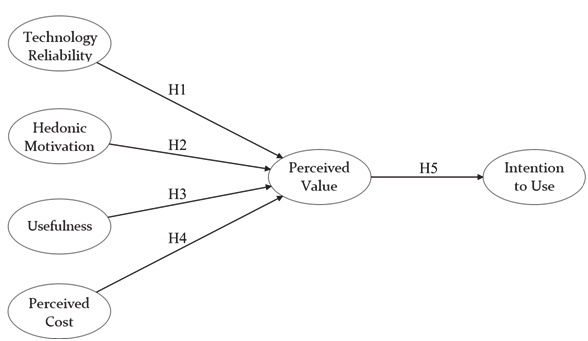
3.1 Technology Reliability
Technological reliability refers to the extent to which a technology is perceived to function accurately, consistently, and safely under various conditions (Ju, 2022). Prior research on technology-based and autonomous mobility services emphasizes that users form value judgments by closely evaluating system reliability, particularly in contexts involving safety-critical operations such as automated or aerial transportation (Al Haddad et al., 2020; Lee, 2020). Reliable technologies reduce uncertainty and perceived risk, thereby enhancing users’ confidence in the benefits they expect to obtain from the service (Ju, 2022; Winter et al., 2020). Studies in intelligent transportation and self-service technologies further indicate that technological reliability strengthens users’ benefit–sacrifice assessments by reinforcing trust in system performance (Al Haddad et al., 2020; Yun & Hwang, 2020). Based on this theoretical reasoning, the present study advances the following hypothesis.
H1. Technological reliability of UAM services is positively associated with perceived value.
3.2 Hedonic Motivation
Hedonic motivation refers to the degree to which the use of a technology is perceived as enjoyable, entertaining, and emotionally rewarding beyond its functional benefits (Venkatesh et al., 2012). Prior studies on technology adoption suggest that experiential and affective gratifications play a crucial role in shaping users’ evaluations of innovative services, particularly in emerging and experiential contexts (Bala et al., 2023; Hartwich et al., 2018). Enjoyment derived from technology use enhances perceived benefits by adding intrinsic value, which complements utilitarian outcomes (Kim et al., 2007). Research on self-service technologies and intelligent transport systems further shows that hedonic experiences intensify users’ overall benefit perceptions, thereby strengthening value assessments (Cho, 2020; Gajdzik et al., 2025; Liu et al., 2018). In light of this theoretical background, the present study puts forward the following hypothesis.
H2. Hedonic motivation of UAM services is positively associated with perceived value.
3.3 Usefulness
Usefulness refers to the degree to which a technology is perceived to enhance task performance, efficiency, and effectiveness in accomplishing daily activities (Davis, 1989). In the technology adoption literature, perceived usefulness has long been recognized as a core cognitive evaluation criterion through which users assess the benefits obtained from using a new system (Aldraiweesh & Alturki, 2025; Hu et al., 2025; Venkatesh, 2000). In mobility and intelligent transportation contexts, usefulness is particularly salient because time savings, convenience, and improved accessibility directly shape users’ benefit perceptions (Al Haddad et al., 2020; Hassn et al., 2016; Kim, 2023; Li et al., 2025; Wang et al., 2021). Prior value-based adoption studies indicate that when users recognize clear functional advantages, they tend to evaluate the overall benefits of the service more favorably (Cho, 2020; Kim et al., 2007). Drawing on this theoretical foundation, the present study proposes the following hypothesis.
H3. Usefulness of UAM services is positively associated with perceived value.
3.4 Perceived Cost
Perceived cost refers to the extent to which users recognize the monetary, time, and effort-related sacrifices required to use a service (Zeithaml, 1988). In consumer value theory, cost is conceptualized as a core sacrifice component that offsets perceived benefits during evaluative judgment processes (Dodds et al., 1991). Prior studies on value-based adoption argue that higher cost perceptions intensify users’ sensitivity to trade-offs, often weakening their overall benefit appraisal (Kim et al., 2007). Research on advanced mobility and self-service technologies further suggests that elevated cost concerns can undermine favorable value evaluations, particularly when pricing uncertainty exists (Ju, 2022; Kim, 2023; Lee, 2020). Accordingly, this study advances the following hypothesis.
3.5 Perceived Value
Perceived value represents users’ overall assessment of the benefits received relative to the sacrifices made when using a service (Zeithaml, 1988). In the value-based adoption literature, value judgments are central to how individuals evaluate whether a technology is worth engaging with in everyday contexts (Kim et al., 2007). Prior studies on digital services and intelligent transportation indicate that when users perceive high overall value, they are more inclined to consider the service worthwhile and personally meaningful (Wong et al., 2025; Yang et al., 2025). Empirical evidence from mobility and smart technologies further suggests that favorable value perceptions translate into stronger motivational readiness toward service usage (Kim et al., 2017; Vishwakarma, 2024). Based on this theoretical reasoning, the present study advances the following hypothesis.
H5. Perceived value of UAM services is positively associated with intention to use.
Ⅳ. Empirical Methodology
4.1 Instrument Development
The measurement instrument was developed based on constructs and items adapted from previously validated studies to ensure conceptual consistency and measurement reliability. All constructs were operationalized using multi-item scales drawn from established research in technology adoption, mobility services, and value-based adoption, as summarized in Table 1
Table 1 The questionnaire employed a five-point Likert scale ranging from 1 (strongly disagree) to 5 (strongly agree), which is commonly used in perception-based behavioral research and allows respondents to express varying degrees of agreement. The perceived cost construct in this study was intentionally operationalized to capture two complementary aspects of cost perception: perceived price level and perceived price salience. Specifically, the first item assesses whether users perceive the cost of UAM services as high, while the second item captures the extent toTable 1 List of Constructs and Items
| Construct | Item | Description | Source |
|---|---|---|---|
| Technology Reliability | TCN1 | Do you believe that UAM technology will operate safely even in unexpected situations? | Ju (2022) |
| TCN2 | Do you think that all functions of UAM will operate accurately? | ||
| TCN3 | Do you think that UAM is a safe transportation service? | ||
| TCN4 | Do you think that UAM technology is a reliable option as a means of transportation for you? | ||
| Hedonic Motivation | HDN1 | Do you think that using UAM services will be an enjoyable experience? | Kim (2023); Cho (2020); Salehan et al. (2017); (Venkatesh et al., 2012) |
| HDN2 | Do you think that you will gain a great deal of enjoyment from using UAM services? | ||
| HDN3 | Do you expect that using UAM services will provide a unique sense of enjoyment that cannot be experienced in everyday life? | ||
| HDN4 | Do you expect to have a satisfying experience when using UAM services? | ||
| Usefulness | USF1 | Do you think that using UAM services will improve the efficiency of your time management in daily life? | Kim (2023); Cho (2020) |
| USF2 | Do you perceive that using UAM services will make your daily life and work more convenient and easier? | ||
| USF3 | Do you think that using UAM services will enhance the efficiency of your daily life and work? | ||
| USF4 | Do you perceive that the introduction of UAM services will provide more options for daily and work-related travel? | ||
| Perceived Cost | CST1 | Do you feel that the cost of regularly using UAM services would be high? | Kim (2023); Cho (2020); Ju (2022) |
| CST2 | Do you think that the cost of using UAM services has a significant influence on your transportation choices? | ||
| Perceived Value | VLU1 | I believe that the benefits of using UAM services outweigh the time required to use them. | Ju (2022); Winter et al. (2020); Kim et al. (2007) |
| VLU2 | I believe that the benefits of using UAM services outweigh the effort required to use them. | ||
| VLU3 | I believe that the benefits of using UAM services outweigh the monetary cost required to use them. | ||
| VLU4 | Do you think that UAM services can provide high value for your daily life and work performance? | ||
| VLU5 | Do you feel that UAM services are a valuable option that meets your travel-related needs and expectations? | ||
| VLU6 | I think that UAM services will be valuable to me overall. | ||
| VLU7 | I think that UAM services will provide high value to me in my daily life. | ||
| Intention to Use | ITN1 | I am willing to use UAM services. | Davis (1989); Kim et al. (2007); Coppola et al. (2024); Karami et al. (2024) |
| ITN2 | I expect that I will use UAM services. | ||
| ITN3 | I am willing to positively recommend UAM services to others. |
To ensure content validity, the initial questionnaire was reviewed through a pre-test involving experts from both academia and industry who possess domain knowledge in transportation systems, information systems, and service innovation. Their feedback led to minor refinements in wording and clarity to improve interpretability. A pilot test was subsequently conducted with voluntary participants from related academic and professional fields to assess item clarity, response consistency, and survey flow. The final instrument reflected revisions informed by both expert evaluation and pilot testing.
4.2 Subjects and Data Collection
Data were collected through an online survey targeting adults aged 19 years or older who had sufficiently understood the concept of domestic air taxi services. A purposive sampling technique was employed to ensure that respondents possessed a basic level of familiarity with UAM services, which is essential for forming meaningful evaluative judgments. The survey was administered using an online panel distributed via Google Forms. Prior to the main questionnaire, respondents were provided with a detailed explanation of UAM and air taxi services, including visual materials and contextual information describing domestic demonstration routes, pricing estimates, operational timelines, and technical characteristics. A screening question was included to verify whether respondents had carefully read and understood the provided information before proceeding.
Participation was voluntary, and anonymity was guaranteed to encourage honest responses and reduce social desirability bias. Respondents were informed of the research purpose, data usage policy, and approximate completion time at the beginning of the survey. The survey instrument was structured into two parts. The first part measured respondents’ perceptions of the main constructs, including technology reliability, hedonic motivation, usefulness, perceived cost, perceived value, and intention to use UAM services. The second part collected demographic information and general mobility-related usage characteristics.
The data collection period spanned from April to September 2024. After data collection, responses were pre-processed through a systematic filtering procedure. Incomplete questionnaires, responses with excessive missing values, and cases failing the screening question were excluded. Additionally, responses exhibiting uniform or patterned answering were removed to enhance data quality. The final dataset was retained for empirical analysis following these criteria. Table 2
Table 2 Profile of the Respondents
| Category | Subcategory | n | % |
|---|---|---|---|
| Gender | Male | 128 | 50.8 |
| Female | 124 | 49.2 | |
| Age (years) | 19–29 | 89 | 35.3 |
| 30–39 | 38 | 15.1 | |
| 40–49 | 64 | 25.4 | |
| 50–59 | 52 | 20.6 | |
| ≥60 | 9 | 3.6 | |
| Occupation | Student | 76 | 30.2 |
| Office worker | 94 | 37.3 | |
| Freelancer | 35 | 13.9 | |
| Professional | 18 | 7.1 | |
| Other | 29 | 11.5 |
Ⅴ. Results
5.1 Reliability and Validity
Internal consistency reliability was assessed using Cronbach’s alpha coefficients. Prior methodological research suggests that values above 0.70 indicate good reliability, while values above 0.60 may be considered acceptable in exploratory research or for constructs with a limited number of items (Nunnally, 1978). As shown in Table 3
Table 3 , most constructs exhibited strong internal consistency, with alpha values well above 0.70. Technology reliability, hedonic motivation, usefulness, perceived value, and intention to use all demonstrated high reliability, indicating stable and consistent measurement. Despite the relatively low Cronbach’s alpha, the perceived cost construct was retained based on both conceptual and empirical considerations. Conceptually, the scale was designed such that higher scores consistently reflect higher perceived cost, ensuring directional consistency across items. Empirically, the factor loadings of the items met acceptable thresholds in the exploratory factor analysis, indicating that each item meaningfully contributes to the underlying construct. Furthermore, givenTable 3 Descriptive Statistics and Reliability
| Construct | Mean | SD | Cronbach’s alpha |
|---|---|---|---|
| Technology reliability | 2.95 | 0.95 | 0.909 |
| Hedonic motivation | 3.84 | 0.95 | 0.916 |
| Usefulness | 3.57 | 1.07 | 0.923 |
| Perceived cost | 3.69 | 1.00 | 0.373 |
| Perceived value | 3.31 | 1.05 | 0.948 |
| Intention to use | 3.20 | 1.07 | 0.910 |
Construct validity was examined using exploratory factor analysis (EFA) to assess whether the measurement items adequately represented their intended latent constructs. EFA was conducted separately for the independent variables and for the mediator and dependent variables to ensure a clear factor structure. Principal component analysis with varimax rotation was employed, which is widely used in early-stage construct validation to maximize factor interpretability. The Kaiser–Meyer–Olkin (KMO) measures exceeded the recommended threshold of 0.80, and Bartlett’s tests of sphericity were statistically significant, confirming the suitability of the data for factor analysis and the presence of sufficient inter-item correlations (Hair et al., 2019). For the independent variables, four distinct factors emerged corresponding to technology reliability, hedonic motivation, usefulness, and perceived cost. All items loaded strongly on their intended factors, with standardized loadings exceeding the commonly accepted cutoff of 0.60, while cross-loadings remained minimal (Table 4
Table 4 Exploratory Factor Analysis Results for Independent Variables
| Construct | Item | Factor 1 | Factor 2 | Factor 3 | Factor 4 |
|---|---|---|---|---|---|
| Technology reliability | TCN1 | 0.881 | 0.099 | 0.147 | 0.007 |
| TCN2 | 0.832 | 0.106 | 0.164 | 0.091 | |
| TCN3 | 0.825 | 0.216 | 0.193 | 0.04 | |
| TCN4 | 0.765 | 0.281 | 0.264 | 0.017 | |
| Hedonic motivation | HDN1 | 0.091 | 0.859 | 0.21 | 0.068 |
| HDN2 | 0.211 | 0.850 | 0.215 | 0.028 | |
| HDN3 | 0.174 | 0.807 | 0.273 | 0.097 | |
| HDN4 | 0.263 | 0.694 | 0.366 | 0.051 | |
| Usefulness | USF1 | 0.166 | 0.242 | 0.839 | 0.031 |
| USF2 | 0.186 | 0.280 | 0.835 | 0.051 | |
| USF3 | 0.31 | 0.186 | 0.814 | 0.042 | |
| USF4 | 0.164 | 0.369 | 0.706 | 0.1 | |
| Perceived cost | CST1 | −.062 | 0.033 | −.062 | 0.849 |
| CST2 | 0.169 | 0.108 | 0.195 | 0.724 |
Similarly, factor analysis of the mediator and dependent variable yielded two clear factors—perceived value and intention to use—with all items retained (Table 5
Table 5 Exploratory Factor Analysis Results for Mediator and Dependent Variable
| Construct | Item | Factor 1 | Factor 2 |
|---|---|---|---|
| Perceived value | VLU1 | 0.841 | 0.277 |
| VLU2 | 0.816 | 0.356 | |
| VLU3 | 0.788 | 0.292 | |
| VLU4 | 0.711 | 0.442 | |
| VLU5 | 0.676 | 0.541 | |
| VLU6 | 0.657 | 0.522 | |
| VLU7 | 0.656 | 0.576 | |
| Intention to use | ITN1 | 0.24 | 0.858 |
| ITN2 | 0.378 | 0.807 | |
| ITN3 | 0.471 | 0.722 | |
| ITN4 | 0.406 | 0.711 |
5.2 Hypothesis Test
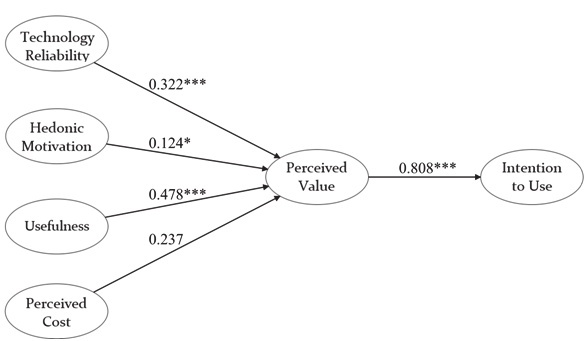
Multiple regression analysis and simple regression analysis were employed to test the hypotheses. Regression is an appropriate analytical technique for assessing the relative explanatory power of multiple independent variables on a single outcome variable while controlling for intercorrelations among predictors (Hair et al., 2019). As reported in Table 6
Table 6 Effects of Independent Variables on Perceived Value
| Independent variable | Dependent variable | B | SE | β | t | p | TOL | VIF |
|---|---|---|---|---|---|---|---|---|
| (Constant) | Perceived value | 1.044 | 1.543 | - | 0.677 | - | - | - |
| Technology reliability | Perceived value | 0.59 | 0.088 | 0.322 | 6.687 | 0.000 | 0.718 | 1.394 |
| Hedonic motivation | Perceived value | 0.232 | 0.100 | 0.124 | 2.325 | 0.021 | 0.585 | 1.71 |
| Usefulness | Perceived value | 0.803 | 0.092 | 0.478 | 8.753 | 0.000 | 0.560 | 1.785 |
| Perceived cost | Perceived value | 0.038 | 0.160 | 0.010 | 0.237 | 0.813 | 0.952 | 1.051 |
To further examine the role of perceived value in shaping behavioral intention, a simple regression analysis was conducted with perceived value as the independent variable and intention to use as the dependent variable. Simple regression is suitable for assessing the direct influence of a single predictor on an outcome variable when the theoretical relationship is well established (Hair et al., 2019). As shown in Table 7
Table 7 Effect of Perceived Value on Intention to Use
| Independent variable | Dependent variable | B | SE | β | t | p | TOL | VIF |
|---|---|---|---|---|---|---|---|---|
| (Constant) | Intention to use | 1.638 | 0.548 | - | 2.987 | - | - | - |
| Perceived Value | Intention to use | 0.483 | 0.023 | 0.808 | 21.004 | 0.000 | 1.000 | 1.000 |
Table 8 Significance Testing Results of the Path Coefficients
| Hypothesis | Hypothesized Path | t-value | p-value | Result |
|---|---|---|---|---|
| H1 | Technology reliability → Perceived value | 6.687 | 0.000 | Supported |
| H2 | Hedonic motivation → Perceived value | 2.325 | 0.021 | Supported |
| H3 | Usefulness → Perceived value | 8.753 | 0.000 | Supported |
| H4 | Perceived cost → Perceived value | 0.237 | 0.813 | Not supported |
| H5 | Perceived value → Intention to use | 21.004 | 0.000 | Supported |
Ⅵ. Discussion
The findings demonstrate that technological reliability plays a central role in shaping perceived value in the context of UAM services. This result aligns with prior studies emphasizing that reliability is a foundational condition for user evaluations of advanced and safety-critical technologies (Al Haddad et al., 2020; Yun & Hwang, 2020). In mobility systems involving automation and aerial operations, users are particularly sensitive to whether the technology can function consistently and safely under uncertain conditions. When technological reliability is perceived as high, users are more likely to focus on the benefits offered by the service rather than potential risks, resulting in more favorable value judgments. This suggests that reliability serves not merely as a technical attribute but as a cognitive assurance mechanism that reduces uncertainty and legitimizes perceived benefits. Similar conclusions have been reported in studies on autonomous mobility and intelligent transportation services, reinforcing the importance of system trustworthiness in early adoption stages (Ju, 2022; Lee, 2020; Winter et al., 2020). In addition, while UAM involves distinctive contextual risks such as safety anxiety, noise concerns, and privacy issues, this study deliberately focused on generalized evaluative constructs within the value-based adoption framework. Specifically, technological reliability was conceptualized as an overarching belief that captures users’ confidence in the safety and performance of the system, which indirectly reflects underlying risk perceptions. Rather than modeling multiple risk dimensions separately, this approach allows for a more parsimonious representation of early-stage user evaluation, where individuals may not yet differentiate between specific types of risk but instead form a holistic judgment regarding system dependability. However, it is also acknowledged that such an approach may not fully capture the multidimensional nature of perceived sacrifices in UAM contexts. As the technology matures and users gain more concrete knowledge and experience, distinct risk perceptions such as aviation anxiety and privacy concerns are likely to emerge as independent determinants of value formation.
Hedonic motivation was also found to significantly enhance perceived value, highlighting the importance of experiential aspects in users’ value assessments of UAM services. This finding is consistent with prior research on technology adoption, which suggests that enjoyment and emotional engagement contribute intrinsic benefits beyond functional performance (Cho, 2020; Gajdzik et al., 2025; Liu et al., 2018). In the case of UAM, the novelty of aerial mobility and the anticipated excitement associated with using such services appear to enrich users’ perceptions of overall value. This indicates that perceived value is not solely derived from rational utility calculations but is also shaped by affective and experiential gratifications. The result echoes earlier findings in self-service and smart technology contexts, where enjoyment amplified users’ benefit perceptions and strengthened evaluative outcomes. Importantly, this suggests that emotional appeal may compensate for uncertainties associated with emerging mobility technologies during their early diffusion phase.
Usefulness emerged as another significant determinant of perceived value, reaffirming its enduring relevance in technology evaluation processes. Prior research has consistently shown that users place substantial weight on whether a technology enhances efficiency, convenience, or task performance (Aldraiweesh & Alturki, 2025; Hu et al., 2025; Venkatesh, 2000). In the UAM context, perceived usefulness appears closely tied to expectations regarding time savings, improved accessibility, and enhanced mobility efficiency. These functional benefits directly contribute to users’ assessments of whether the service is worthwhile in everyday and work-related travel. The finding is consistent with value-based adoption studies, which argue that perceived usefulness represents a core benefit component that elevates overall value perceptions (Kim et al., 2007; Kim et al., 2017; Wong et al., 2025). This reinforces the notion that even in highly innovative and experiential services, utilitarian considerations remain fundamental to how users evaluate value. Comparable patterns have been observed in studies on autonomous transport and smart mobility systems, underscoring the robustness of this relationship across technological contexts (Al Haddad et al., 2020; Hassn et al., 2016; Kim, 2023; Li et al., 2025; Wang et al., 2021).
In contrast, perceived cost did not exhibit a significant relationship with perceived value, diverging from traditional value-based adoption expectations. Within the value-based adoption framework, cost is conceptualized as a key sacrifice component encompassing both monetary and non-monetary aspects, such as financial burden, time, and effort (Kim et al., 2007). Prior research consistently indicates that higher perceived costs reduce overall value by intensifying perceived sacrifices, particularly in well-established service contexts where users have clear reference points for evaluation (Dodds et al., 1991). However, in emerging mobility contexts such as UAM, users may not yet possess sufficiently concrete knowledge to accurately assess these sacrifice components. One plausible explanation is that UAM remains largely conceptual for many respondents, limiting their ability to form stable perceptions of pricing and usage-related burdens. In such situations, users tend to rely more heavily on anticipated benefits, such as efficiency, novelty, and experiential value, rather than engaging in a detailed benefit–sacrifice trade-off. Similar patterns have been observed in studies on emerging technologies, where perceived cost plays a less salient role during early adoption stages due to high uncertainty and lack of experiential grounding (van der Heijden, 2004; Venkatesh et al., 2012). At the same time, this non-significant finding should be interpreted with caution due to potential measurement limitations associated with the perceived cost construct. The relatively low internal consistency suggests that the two items may capture distinct dimensions of cost perception, namely perceived price level and decision sensitivity to cost, rather than a single homogeneous construct. This measurement issue may have attenuated the observed relationship between cost and perceived value, implying that the empirical result should not be interpreted as definitive evidence of the irrelevance of cost in UAM adoption. Future research is therefore encouraged to refine and validate multi-dimensional cost measures to better capture the complexity of sacrifice perceptions in emerging mobility contexts. In addition, the sampling strategy employed in this study may have influenced the observed results. Because the sample consisted of respondents who had prior awareness of UAM concepts, it is possible that participants were more favorably predisposed toward the technology, leading to elevated perceptions of hedonic motivation and perceived value. Furthermore, the relatively high proportion of younger respondents and students, who are generally less price-sensitive, may have attenuated the influence of perceived cost on value formation. Therefore, the non-significant effect of cost should also be interpreted in light of potential sampling bias.
Finally, perceived value was found to strongly influence intention to use, confirming its role as a pivotal mechanism translating evaluative beliefs into behavioral readiness. This result is consistent with consumer value theory, which posits that individuals are more inclined to adopt services they perceive as offering favorable benefit–sacrifice trade-offs (Zeithaml, 1988). In the UAM context, when users judge the service as valuable overall, they are more likely to consider it meaningful, worthwhile, and relevant to their mobility needs. This finding supports prior empirical evidence demonstrating that perceived value serves as a proximal antecedent to usage intention in both digital and mobility services (Wong et al., 2025; Yang et al., 2025). It also validates the positioning of perceived value as a mediating construct within the research model, integrating multiple cognitive and affective evaluations into a unified driver of adoption intention.
In addition to the empirical findings, this study provides important theoretical reflections on the applicability of the value-based adoption model in emerging mobility contexts. Although the model incorporates both benefit and sacrifice dimensions, the non-significant effect of perceived cost suggests that the sacrifice component may not yet be fully activated in the context of UAM. One plausible explanation is that UAM remains largely conceptual for many respondents, making it difficult to form concrete evaluations of monetary or non-monetary sacrifices. Unlike mature services where pricing and effort are clearly experienced, users in early-stage technologies may rely more heavily on anticipated benefits such as efficiency and novelty when forming value judgments. This implies that, rather than functioning as a fully balanced benefit–sacrifice evaluation, perceived value in this context may be temporarily dominated by benefit-oriented cognition. Therefore, the findings do not necessarily contradict the theoretical structure of VAM but instead highlight a stage-contingent limitation, where the relative importance of sacrifice factors depends on the maturity and experiential accessibility of the service. This also differentiates the present study from traditional TAM-based approaches, as it demonstrates when and why sacrifice dimensions may become less salient in early adoption stages.
Ⅶ. Conclusion
7.1 Theoretical Contributions
This study contributes to the technology adoption literature by advancing a value-centered explanation of user acceptance in the emerging context of UAM services. While prior research on advanced mobility and autonomous transportation has predominantly focused on isolated determinants such as safety, trust, or usefulness, this study integrates technological reliability, hedonic motivation, usefulness, and perceived cost within a unified value-based adoption framework. In doing so, it demonstrates that perceived value operates as a central cognitive mechanism through which diverse evaluative beliefs are synthesized and translated into adoption intention.
A key theoretical contribution lies in clarifying the relative roles of benefit-oriented and sacrifice-oriented beliefs in shaping perceived value. Previous studies often assumed that perceived cost would exert a consistent negative influence on value assessments, following classical consumer value theory (Kim et al., 2007; Zeithaml, 1988). However, this study reveals that cost perceptions do not significantly shape perceived value in the UAM context, suggesting that existing value-based models may not fully capture user evaluations of radical, future-oriented mobility technologies. This finding extends earlier work on emerging technologies by empirically demonstrating that benefit salience can outweigh cost considerations when users lack concrete price reference points or market experience (Ju, 2022; Lee, 2020).
In addition, this study enriches adoption theory by jointly examining utilitarian and experiential benefits. While prior mobility studies have emphasized functional efficiency and reliability, the present findings show that hedonic motivation independently contributes to value formation. This highlights that emotional and experiential gratifications are not peripheral but integral to how users evaluate advanced transportation services, extending insights from hedonic system research into the mobility domain (Cho, 2020; van der Heijden, 2004). For scholars, these findings suggest the need to reconceptualize value formation in early-stage technologies as a multidimensional process shaped by both rational performance expectations and affective anticipation. Future theoretical models should therefore move beyond purely instrumental assumptions and explicitly incorporate experiential and symbolic dimensions when explaining adoption of next-generation mobility services.
7.2 Business Implications
This study offers several actionable implications for practitioners involved in the development, regulation, and commercialization of UAM services. First, the strong influence of technological reliability on perceived value underscores the importance of visibly demonstrating system stability and safety. Service providers should prioritize transparent communication regarding operational reliability, such as real-time monitoring systems, redundancy mechanisms, and safety certifications. For example, showcasing simulated emergency handling scenarios or publicly sharing reliability test outcomes may help potential users better appreciate the robustness of UAM technologies.
Second, the significant role of hedonic motivation suggests that UAM services should be positioned not only as efficient transport solutions but also as engaging mobility experiences. Operators can design service touchpoints that emphasize enjoyment and emotional appeal, such as panoramic cabin designs, immersive digital interfaces, or personalized in-flight experiences. Marketing strategies that highlight the excitement and uniqueness of aerial travel may be particularly effective in shaping favorable value perceptions during early market introduction.
Third, the impact of usefulness on perceived value indicates that practical benefits remain critical. Service providers should clearly articulate how UAM services improve daily mobility, such as reducing commute time, bypassing congestion, or improving access to underserved areas. Integrating UAM with existing transportation systems through seamless booking platforms or intermodal connections may further enhance perceived usefulness.
Interestingly, the non-significant role of perceived cost suggests that pricing strategies may be less influential at the current stage than commonly assumed. Rather than competing on price, early-stage providers may benefit from value-focused positioning that emphasizes benefits and experience. Policymakers and regulators can also leverage this insight by supporting pilot programs or demonstration projects that allow users to experience UAM services firsthand, thereby strengthening perceived value before cost becomes a dominant concern. Collectively, these implications highlight the importance of aligning technological design, service experience, and communication strategies around value creation rather than cost minimization.
7.3 Limitation and Further Research
Despite its contributions, this study has several limitations that provide directions for future research. First, user evaluations were based on anticipated perceptions rather than actual usage experiences, which may evolve as UAM services become operational. Longitudinal studies tracking value perceptions before and after real-world adoption would offer deeper insights into how evaluative mechanisms develop over time. Second, this study focused primarily on individual-level cognitive and affective beliefs, leaving broader social and institutional influences unexplored. Future research could examine how media discourse, public trust in regulatory institutions, or societal attitudes toward aviation shape value formation. Third, comparative studies across countries or mobility systems would help determine whether value-based adoption processes vary depending on cultural context or transportation infrastructure maturity. Fourth, the perceived cost construct exhibited low internal consistency, indicating potential measurement limitations. Future studies should develop and validate multidimensional cost scales that distinguish between perceived price level and cost salience. Experimental approaches may also provide more precise insights into how cost perceptions evolve as UAM services become commercially available. Fifth, the use of purposive sampling targeting respondents with prior awareness of UAM may have introduced a pro-innovation bias. Individuals familiar with emerging technologies are more likely to report higher perceived value and enjoyment, potentially inflating benefit-related evaluations. In addition, the sample was skewed toward younger respondents and students, who may exhibit lower price sensitivity, thereby weakening the observed effect of perceived cost. Future research should therefore employ more diverse and representative samples to enhance generalizability. Moreover, the limited role of perceived cost may reflect the early-stage and largely conceptual nature of UAM, where users have not yet formed concrete expectations regarding economic and non-economic sacrifices. This may attenuate the activation of the sacrifice dimension emphasized in the value-based adoption model. Finally, future research should incorporate context-specific risk factors—such as safety anxiety, noise concerns, and privacy risks—to more comprehensively capture the multidimensional nature of perceived sacrifices in UAM adoption.